Polymarket vs Kalshi: The 60-Second Verdict
Polymarket and Kalshi are both prediction markets but operate in different legal universes. Polymarket is decentralized, USDC-based, blocked in the U.S., and runs the deepest political and geopolitical markets. Kalshi is CFTC-regulated, U.S.-legal, fiat-funded, and dominates compliant event contracts.
If you are a U.S. trader, you cannot legally use Polymarket — Kalshi is your only option. If you are outside the U.S. and want depth on politics, crypto prices, sports, and geopolitics, Polymarket has roughly 10x the volume and 5x the active traders. WinPolymarket is an independent tracker for the Polymarket side of that split.
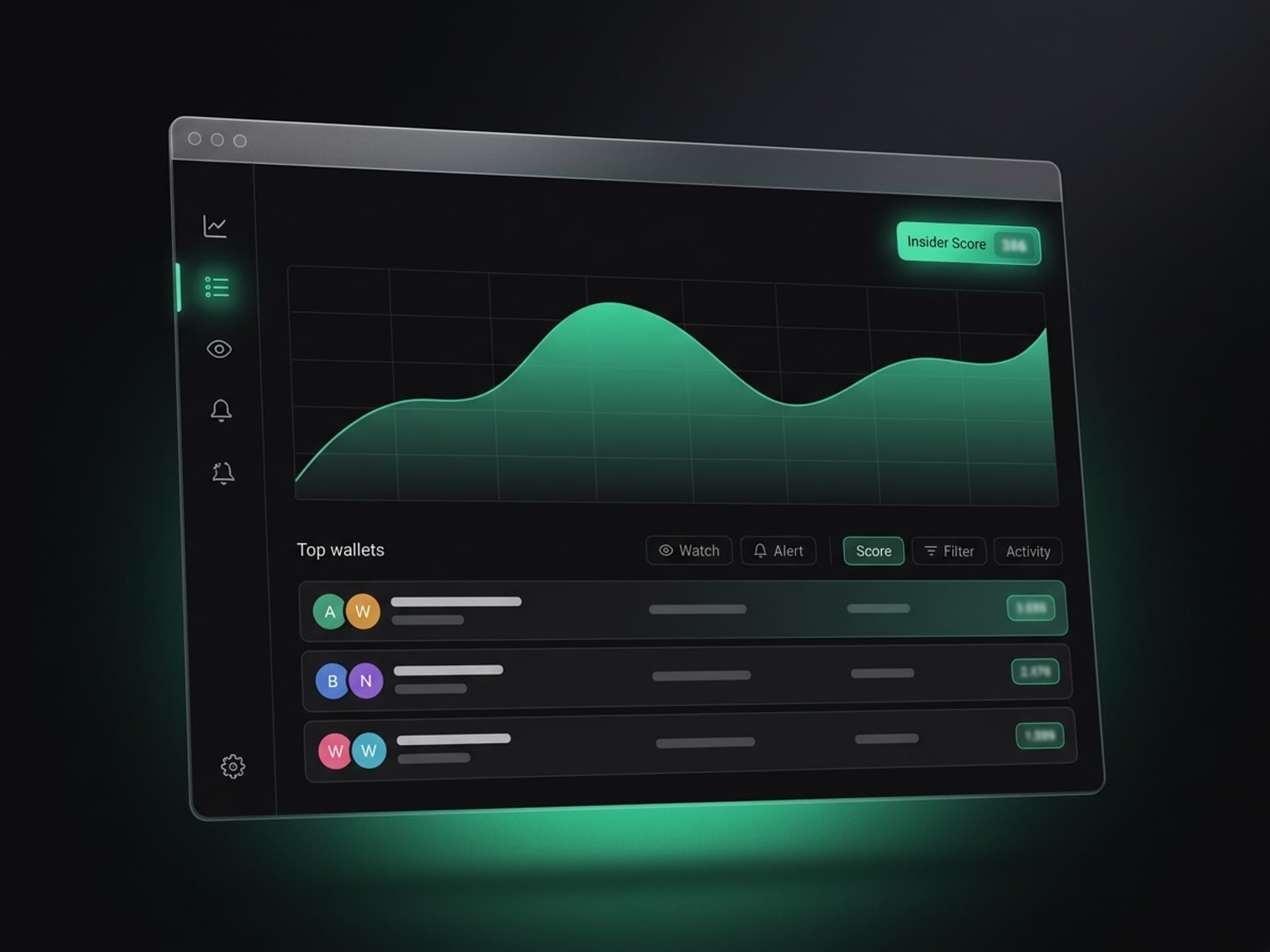
Follow Polymarket smart money before the public.
TL;DR Comparison Table
| Criterion | Polymarket | Kalshi |
|---|---|---|
| Legal status (U.S.) | Blocked | CFTC-regulated, legal |
| Settlement asset | USDC on Polygon | USD via bank/ACH |
| Trading fees | 0% on most markets | ~1 — 7% per contract (tiered) |
| Market depth (top markets) | $50M — $200M open interest | $1M — $20M open interest |
| Market types | Politics, sports, crypto, geopolitics, culture | Politics, economics, weather, some sports |
| Order book visibility | Public on-chain | Private (Kalshi internal) |
| Insider visibility | Every trade public on Polygon | Only aggregated public data |
| Withdrawal fee | Up to 2% in some flows | None on most flows |
| Minimum bet | ~$1 USDC | $1 |
| 2024 election volume | $8B+ | $300M+ |
| Smart-money tracking tools | WinPolymarket (independent) | Limited |
Why Compare These Two?
Polymarket and Kalshi solve the same question — "what is the market's probability of this event?" — with completely different architectures. Picking the wrong one for your jurisdiction or trading style burns weeks of friction.
This comparison is independent. We build WinPolymarket on Polymarket data, so we will tell you exactly when Kalshi is the better choice. The honest answer is: it depends on geography first, market type second.
Legal Status: The Single Most Important Difference
Polymarket
- Not available to U.S. persons following the 2022 CFTC settlement
- Operates in most of Europe, Asia, Latin America with KYC at withdrawal
- Decentralized: runs on Polygon, non-custodial smart-contract wallets
- Operator: Polymarket Holdings PBC, based outside the U.S.
- Bypassing geo-blocks via VPN violates terms and can lock funds at withdrawal
Kalshi
- CFTC-regulated, fully legal in the U.S. since 2021 (additional approvals in 2023 — 2024)
- Available in 50 U.S. states (some product limitations vary by state)
- Centralized exchange model: KYC at signup, fiat funding via ACH/bank, full compliance
- Operator: KalshiEX LLC, U.S.-based
The practical answer: If you are in the U.S., this comparison is over before it starts. You use Kalshi. The rest of this article is mostly for non-U.S. traders or for U.S. traders evaluating relative platform mechanics.
For non-U.S. traders, Polymarket is the larger, deeper, more liquid choice. See What Is Polymarket for the foundational walkthrough.
Follow Polymarket smart money before the public.
Fees: Polymarket Wins on Cost, but Not by as Much as the Top-Line Says
Polymarket charges 0% trading fee. Kalshi charges a tiered fee structure that lands roughly $0.01 — $0.07 per $1 contract, depending on volume and price band.
That sounds like a clear Polymarket win. The catch:
- Polymarket charges a withdrawal fee up to 2% in some flows (varies by market and frequency)
- Kalshi's bank withdrawal is free
- Polygon gas is real but cheap ($0.01 — $0.10 per trade)
For a trader cycling $10K monthly with 50 trades, the cost breakdown looks like:
| Cost | Polymarket | Kalshi |
|---|---|---|
| Trading fees | $0 | ~$50 — $200 |
| Network gas / banking | ~$2 — $5 | $0 |
| Withdrawal | up to ~$200 (one $10K withdrawal at 2%) | $0 |
| Effective total | $0 — $205 | $50 — $200 |
In practice, both platforms net out roughly similar for high-volume traders. For low-volume, infrequent traders, Polymarket's 0% trading fee wins decisively.
Market Depth: Polymarket Has the Liquidity Polls Trust
Liquidity is the variable that matters most for traders sizing $1K+ positions. Thin markets move on your trade; deep markets do not.
Polymarket 2024 election cycle stats:
- $8B+ cumulative volume
- Single-day record over $170M
- Top market open interest over $200M
Kalshi 2024 election cycle stats:
- $300M+ cumulative volume (a record for a CFTC-regulated event-contracts venue)
- Top market open interest around $20M
For political markets specifically, Polymarket prices have repeatedly been adopted by Bloomberg, the Financial Times, and the Wall Street Journal in reporting because the depth makes them harder to manipulate. Kalshi's prices are increasingly cited too, especially post-2024 — but its depth is still an order of magnitude lower.
For thin-market traders trying to detect informed flow (the whale-tracking use case), Polymarket's depth + public on-chain order books is unbeatable.
Market Types: Different Strengths
Polymarket dominates
- Politics worldwide, not just U.S. — French elections, UK polls, EU referenda, Latin American races
- Geopolitics — strikes, conflicts, peace deals (regulated venues legally cannot list most of these)
- Crypto prices — BTC, ETH, SOL price targets at various dates
- Cultural events — Oscars, music charts, AI model releases, anything with public attention
Kalshi dominates
- U.S. politics at scale post-regulatory approval
- Economic data — CPI prints, Fed decisions, unemployment numbers
- Weather — Kalshi's hurricane, heat, and rainfall markets are unique in regulated venues
- U.S.-legal sports markets in jurisdictions where sportsbooks are restricted
Side-by-side example: 2024 election
Polymarket's main "Will Trump win 2024?" market traded $3B+ in volume. Kalshi's equivalent market traded ~$200M, capped earlier by listing approval timing. Both ended up near 50/50 the week before election day and resolved at $1 on the Trump side. Same price discovery, very different liquidity.
Why This Matters for Smart-Money Trackers
Polymarket's public on-chain order books mean every trade — wallet, size, time — is visible permanently. Kalshi's order book is internal: you see aggregated volume and price, but not individual positions.
For whale-watching and insider-flow detection, this is the single biggest difference. You cannot build a Nansen-equivalent for Kalshi — the data is not public. You can absolutely build one for Polymarket. That is exactly what WinPolymarket is.
Claim your spot for pre-beta access →
Pre-beta opens July 2026 with a 5,000-player cap. Insider Scores per wallet, watchlist alerts, public wallet profile pages.
Which Should You Pick? Decision Matrix
If you are a U.S. trader
Kalshi. Polymarket is not legally available to you. Do not bypass geo-blocks — KYC at withdrawal will catch it. Kalshi's product is improving fast and now lists many of the markets U.S. traders previously had to go offshore for.
If you are outside the U.S. and trade $5K+ positions
Polymarket. Depth, 0% trading fee, public order books, more markets. The 2% withdrawal fee in some flows is a real cost, but for buy-and-hold-to-resolution traders it is one-time. Add WinPolymarket on top to track informed flow.
If you are outside the U.S. and trade small ($50 — $500)
Either. Both work. Polymarket's slightly cheaper trading fees matter less at small size. Pick based on which market types interest you (geopolitics → Polymarket; weather → Kalshi).
If you want regulatory protection
Kalshi. CFTC oversight, SIPC-equivalent protections in some flows, U.S. legal recourse. Polymarket's smart-contract architecture is robust but you have no consumer-protection layer.
If you want to track smart money
Polymarket, with WinPolymarket layered on top. Kalshi's data is not public enough to build whale-tracking tooling. Polymarket's is fully public on Polygon. Claim your spot for the launch alert.
Frequently Asked Questions
Which has bigger markets, Polymarket or Kalshi?
Polymarket is roughly 10x larger by volume and 5x larger by active traders as of 2026. Polymarket cleared $8B+ in 2024 election cycle volume vs Kalshi's ~$300M. Kalshi is growing fast post-regulatory approval but is still well behind on depth for political markets.
Is Kalshi safer than Polymarket?
Kalshi has CFTC regulation, which provides consumer protections Polymarket cannot offer. Polymarket has smart-contract architecture that has run since 2020 with no major exploit. They are safer in different ways — Kalshi for regulatory recourse, Polymarket for non-custodial control. Pick based on which type of safety you value.
Can I use both Polymarket and Kalshi from the same country?
If you are outside the U.S., yes — both accept international users in most jurisdictions, with KYC at withdrawal. If you are in the U.S., only Kalshi is legally available. WinPolymarket tracks Polymarket activity specifically — claim your spot for our pre-beta launch.
Does Polymarket or Kalshi have more accurate prices?
In deep markets, both are highly accurate — often more accurate than polls or expert forecasts. Polymarket's deeper liquidity tends to produce slightly tighter spreads in political markets. Kalshi's prices for U.S. economic data (CPI, jobs reports) are often more accurate due to the structured nature of those markets.
Can I arbitrage between Polymarket and Kalshi?
In theory, yes — when the same event trades at different prices on the two platforms. In practice, U.S./non-U.S. legal split makes cross-platform arbitrage difficult for most retail traders, and fee structures (2% Polymarket withdrawal vs Kalshi's tiered trading fee) compress the spread that needs to exist before arbitrage is profitable.
Which platform is better for whales and smart-money traders?
Polymarket, by a wide margin. Polymarket's depth means a $250K position is absorbable in major markets; on Kalshi it would move the market 5 — 10%. Polymarket's public on-chain order books also enable third-party tools like WinPolymarket to score wallets and surface informed flow — something structurally impossible on Kalshi.
Will Polymarket return to the U.S.?
Unclear as of 2026. Polymarket has expressed interest in CFTC regulation but has not announced a U.S. relaunch. Kalshi's CFTC approvals have made the regulatory path clearer, but Polymarket's existing 2022 settlement complicates re-entry. For U.S. traders, Kalshi is the only legal option and likely to remain so through 2026 — 2027.
The Bottom Line
Polymarket wins on depth, fees, and market breadth — and is the only platform where smart-money tracking is even possible. Kalshi wins on U.S. legality and regulatory protection. Geography first, market type second. Most non-U.S. traders end up on Polymarket; most U.S. traders end up on Kalshi.
WinPolymarket is the independent tracker for the Polymarket side of this split.
Claim your spot for pre-beta access →
WinPolymarket is independent and not affiliated with, endorsed by, or sponsored by Polymarket Holdings PBC or KalshiEX LLC. All trademarks belong to their respective owners.
Want in early? Claim your spot on winpolymarket.com →